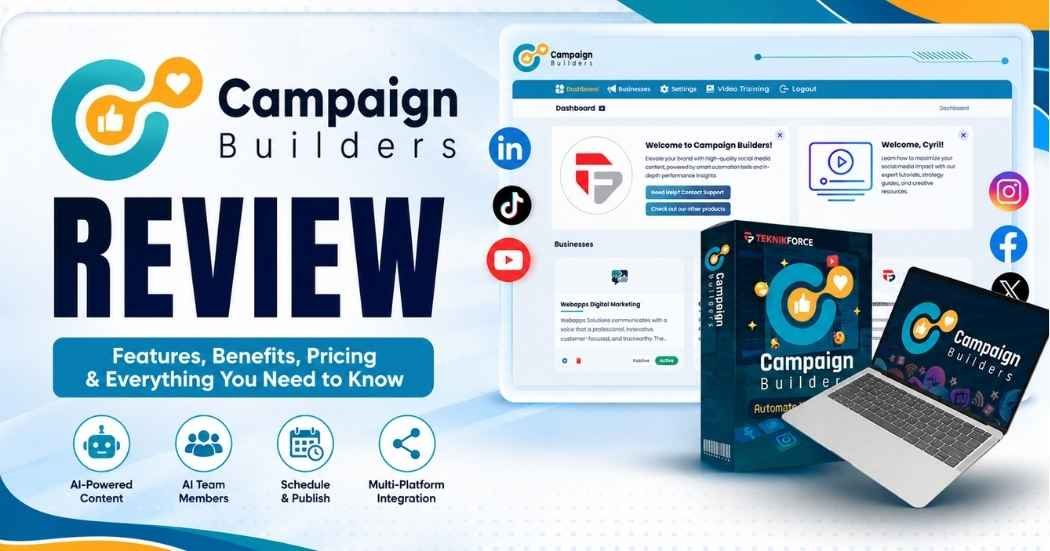
Keeping up with social media content is exhausting. You need fresh posts, a consistent brand voice, edits nobody has time for, and a schedule that actually gets followed. Most marketers I know are juggling three or four tools just to keep one campaign moving. Half of that time goes into busywork instead of strategy.
That’s the gap CampaignBuilders is trying to fill. Rather than acting as one more AI writing box, it’s built around AI “team members.” They handle different pieces of a campaign. Think branding, engagement, reporting, and more. The idea is appealing on paper. The real test is whether it holds up once you look past the sales page.
This CampaignBuilders review 2026 breaks down what the platform actually does. It covers the FE and PRO plans, each CampaignBuilders OTO, the CampaignBuilders pricing, and the CampaignBuilders pros and cons. It also covers who should, and shouldn’t, buy it. If you’re searching for an honest CampaignBuilders review, this covers what the sales page won’t tell you.
Product Overview
Before diving into the full CampaignBuilders review, here’s the short version. CampaignBuilders is a social-media-first marketing platform that pairs AI content generation with campaign management tools. It’s sold through a front-end offer plus a stack of upgrades that expand its reach into blogging and phone automation.
Detail | Information |
Product Name | CampaignBuilders |
Platform Type | Cloud-based AI marketing software |
Main Purpose | AI-powered social media campaign creation and management |
Payment Model | One-time payment promotional offer |
Front-End Offer | CampaignBuilders Elite |
Upgrade Structure | PRO, Reseller License, Blogi AI PRO, Callsi PRO |
What Is CampaignBuilders?
At its base, CampaignBuilders is meant to cut down the manual work of running social media campaigns. Instead of opening a chat window and typing prompts every time you need a caption, you set up your brand once. From there, the AI team works from that context.
The AI Team Members idea is what separates it from a generic writing tool. You’re not talking to one assistant that does everything passably; you’re assigning tasks to roles built around specific marketing jobs. That structure matters more than it sounds like it should. It’s especially useful once you’re running several campaigns at once and don’t want to re-explain your brand every single time.
Brand customization sits underneath all of this. You feed the platform your brand identity, industry, and voice, and that context shapes what the AI produces. It won’t nail your tone every time. But it’s a meaningfully better starting point than a blank prompt box.
CampaignBuilders also supports multilingual content and a full publishing workflow. It doesn’t just draft posts and leave you to figure out the rest. Put together, this is closer to a campaign-management system with AI built in. It’s not just a simple AI writer with a new coat of paint. Keep that in mind for the rest of this CampaignBuilders review.
How CampaignBuilders Works
The next part of this CampaignBuilders review walks through the actual workflow, step by step.
- Set up your brand. Enter your business details, industry, and general marketing context so the AI has something to work from.
- Configure brand voice and preferences. Define tone, style, and any specific guidelines you want the AI to follow.
- Set up your AI Team Members. Assign roles for the marketing tasks you need covered, whether that’s writing, engagement, or reporting.
- Select content topics and language. Choose the subjects your campaign should cover and which language the content should be generated in.
- Choose an AI model where applicable. On plans with broader access, pick which underlying AI model handles a given task.
- Generate campaign content. The AI team produces drafts based on everything configured in the steps above.
- Review and edit. Go through the output, fix anything off-brand or inaccurate, and revise as needed.
- Schedule or share. Send the finished content out through the platform’s publishing workflow, including its Buffer connection.
None of this removes the need for a human to check the work before it goes live. But it does turn a scattered process into something you can repeat every week without reinventing it.
CampaignBuilders Key Features
The CampaignBuilders features below cover what you’ll actually be working with day to day, from content generation to publishing. These are the building blocks that show up in nearly every CampaignBuilders PRO and FE walkthrough.
AI Team Members
Instead of one all-purpose assistant, you get role-based AI members configured around specific marketing tasks. It’s a small shift that makes a real difference once your content calendar gets busy.
AI Content Generation
The platform drafts marketing and social copy using your brand settings and campaign configuration as context. It speeds up production, but the output still needs a human pass before publishing.
Multiple AI Models
FE users get limited AI options, while PRO unlocks access to several underlying models. Different models write differently, so more access generally means more usable output for high-volume users.
Brand Identity & Brand Voice
You can set your brand name, industry, and voice so generated content sounds less generic. It’s a helpful layer, though it won’t guarantee perfect consistency across every single post.
Content Topics & Preferences
Topics, language, and other preferences shape what the AI focuses on. This turns content creation into something closer to a repeatable system than a one-off request.
Multilingual Content Creation
Content can be generated in several languages, including English, Hindi, Chinese, Spanish, French, and Arabic. Useful for reaching different markets, though translations still deserve a native-speaker review before anything goes out.
Social Media Campaign Management
Content lives inside campaigns tied to a product, offer, or business goal, rather than sitting as disconnected posts. That structure is especially useful once you’re running more than one thing at a time.
Content Scheduling & Publishing
Once content is approved, it moves into a scheduling workflow rather than requiring manual copy-paste into another tool. This is where a lot of the day-to-day time savings actually show up.
Buffer Integration
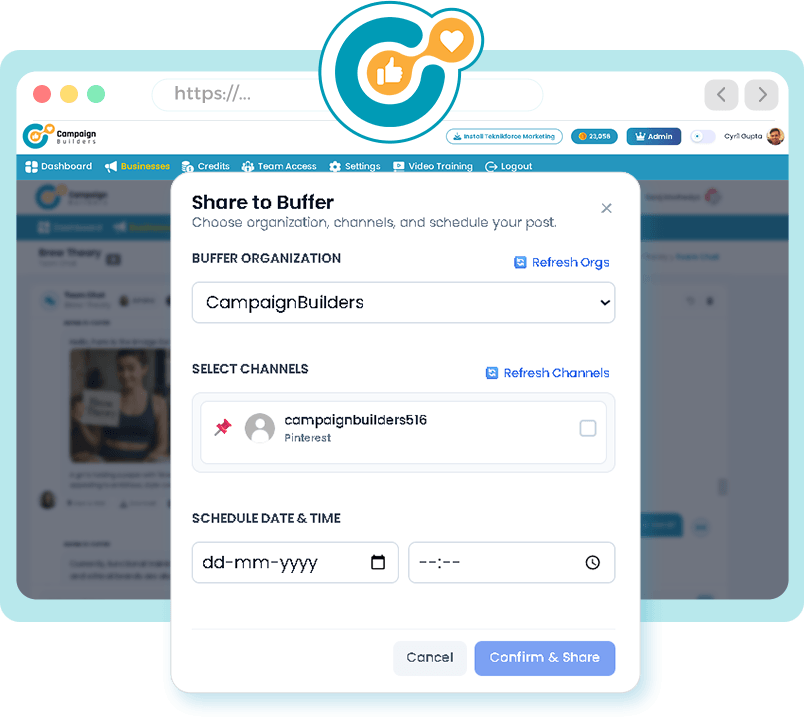
CampaignBuilders connects to Buffer for publishing, letting you pick an organization, channel, and time slot from inside the platform. It’s convenient if Buffer is already part of your stack.
Team Access
PRO adds Team Access, which matters once more than one person is touching a campaign. Agencies and in-house teams get the most out of this.

AI Team Members
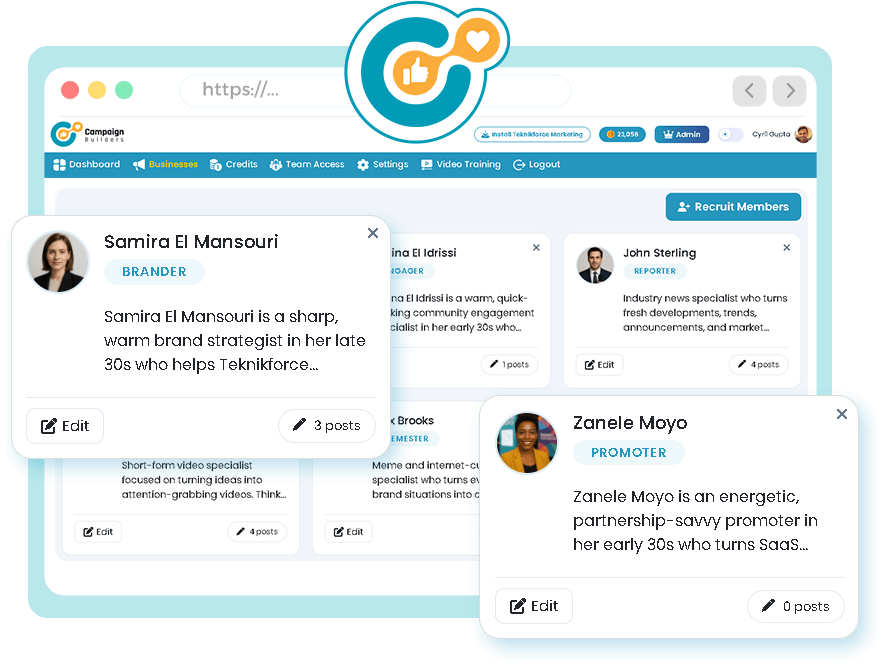
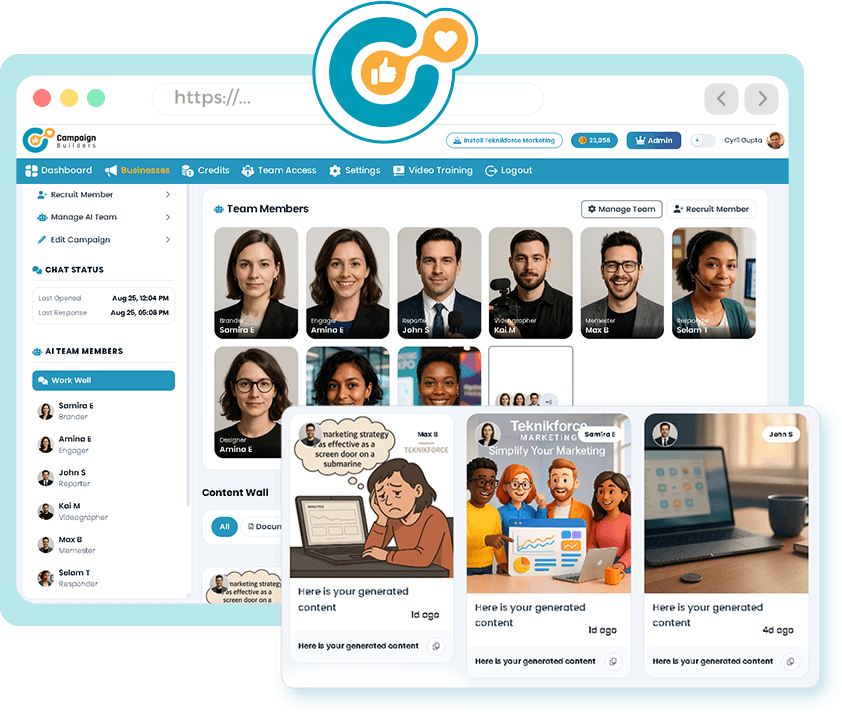
The AI Team Members concept is probably the most distinctive part of CampaignBuilders. Rather than repeatedly prompting a single chatbot, you configure separate AI roles built around different marketing functions. Each one handles its own slice of the workflow.
From what’s shown in the platform, the available roles include a Brander, an Engager, a Reporter, a Videographer, and a Promoter. These are software roles running on AI models, not actual staff. Think of them as pre-configured task specialists rather than employees with judgment of their own.
This setup can genuinely simplify a busy content calendar because you’re not manually re-explaining context every time you switch tasks. It doesn’t replace strategic decisions, though. Someone still has to decide what the campaign is actually trying to achieve.
AI Role | Potential Purpose |
Brander | Helps establish and apply brand identity across content |
Engager | Focuses on audience interaction and engagement-style posts |
Reporter | Handles reporting and campaign summary tasks |
Videographer | Assists with video-related content needs |
Promoter | Focuses on promotional and offer-driven content |
AI Content Generation
Of all the CampaignBuilders features, content generation is the one doing the most day-to-day work. It leans on your AI Team Members to produce marketing copy that fits your campaign. The output also draws from your brand settings, so it’s meant to be more tailored than a generic prompt-and-response tool.
That said, AI-generated marketing copy is only as good as the review process around it. Claims, links, offer details, and tone all need a human check before anything gets published, especially for regulated or higher-stakes niches. Skipping that step is where AI content tends to get marketers into trouble.
The revision workflow matters here too. FE includes basic editing, while PRO adds unlimited revisions. That’s a real difference if you’re the type who rewrites a post three or four times before it feels right.
None of this guarantees better marketing results. It mainly removes some of the blank-page friction and gives you a faster first draft to work from. Whether that draft turns into a good post still comes down to the person reviewing it.
Multiple AI Models
Access to more than one AI model is one of the clearer differences between the FE and PRO tiers of CampaignBuilders PRO. Different models tend to write differently. Having options can matter if you’re producing a large volume of varied content.
The interface shows access to models including Gemini, GPT, Claude, and Grok, depending on your plan. FE is described as having Limited AI Options, while PRO advertises Multi-AI Access along with more advanced AI capabilities.
If you’re a casual user posting occasionally, the FE’s limited access is probably fine. If you’re producing daily content across multiple campaigns, broader model access on PRO is going to save you more friction.
Confirmed model options shown in the platform:
- Gemini
- GPT
- Claude
- Grok
Brand Identity & Brand Voice
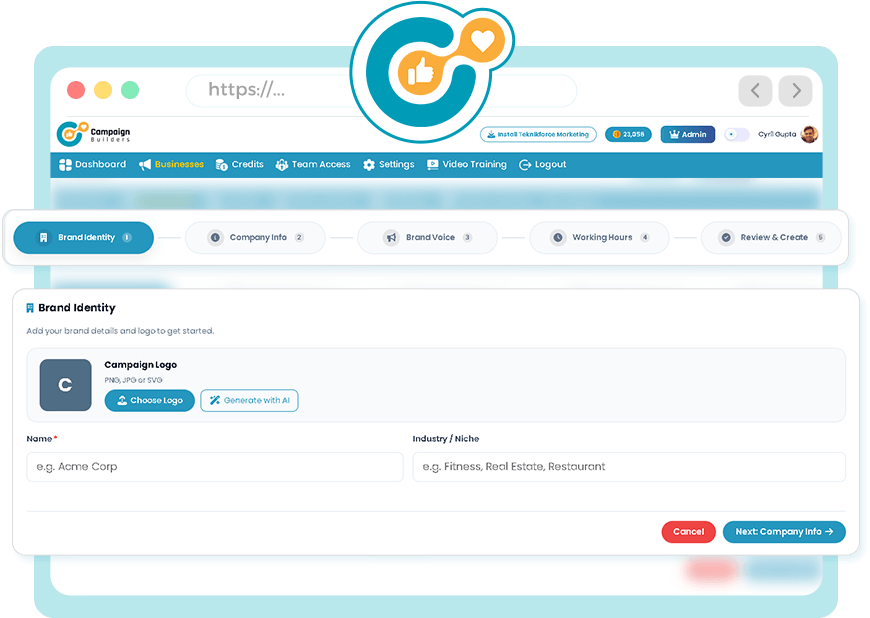
Generic AI content is the biggest complaint marketers have about automation tools. CampaignBuilders tries to fix that through its brand settings. You can set your brand name, logo, industry, and voice. This gives the AI actual context instead of a guess.
This matters more than it might seem. A financial services brand and a skincare brand shouldn’t sound the same. Giving the AI that distinction up front cuts down on how much rewriting you’ll need to do later.
For agencies juggling several clients, this feature earns its keep fast. Switching between brand profiles is faster than re-briefing an AI assistant every time you start a new client.
It’s worth being realistic about the limits, though. Brand settings improve the starting point, but they don’t guarantee every single post will sound exactly like your business. You’ll still catch things that need adjusting.
Content Topics & Preferences
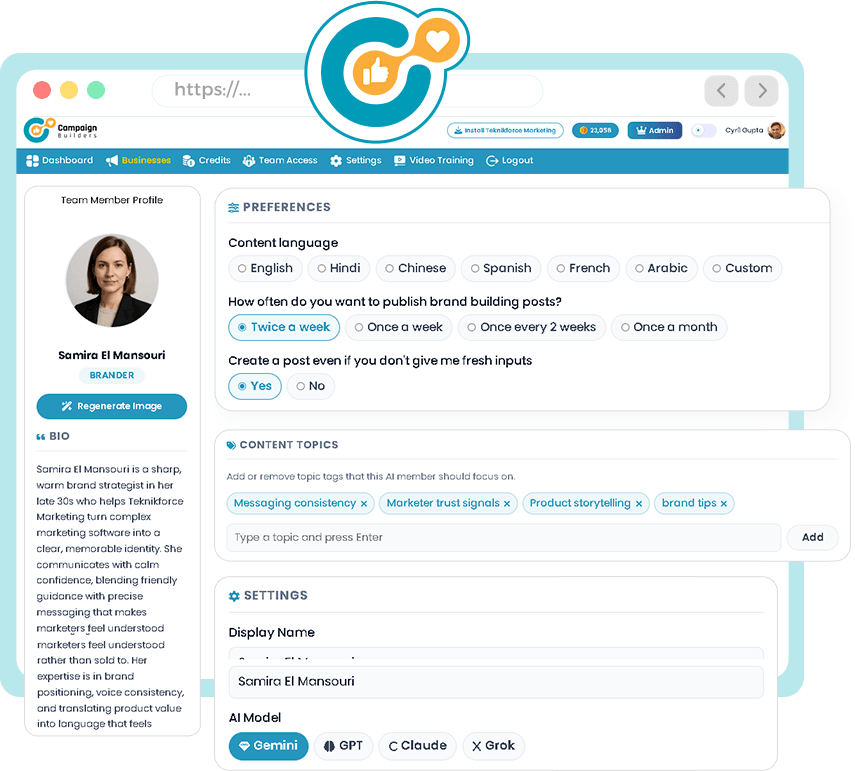
Beyond brand voice, CampaignBuilders lets you define what your content should actually be about. Topics, language, and publishing frequency all factor into what the AI generates. This keeps output aligned with your actual campaign goals instead of drifting into generic filler.
This is where the platform starts to feel less like a one-off generator. It becomes more like a system you can run week after week. Once your preferences are set, you’re not rebuilding the brief from scratch every time you need new content.
Confirmed preference options include:
- Content topics
- Content language
- Publishing frequency
- AI-related preferences
Multilingual Content Creation
CampaignBuilders supports content generation in multiple languages, which is useful if you’re marketing to more than one region or audience group. The available options shown in the platform include English, Hindi, Chinese, Spanish, French, Arabic, and a custom setting.
For a US-based marketer running English-language campaigns most of the time, this feature may not come up often. But for agencies or businesses serving international clients, having language options built in saves a step compared to translating content separately.
It’s important not to overestimate what this gives you, though. Selecting a language produces content in that language, not a guaranteed native-quality translation. Anything customer-facing in a language you don’t speak fluently deserves a native-speaker review before it goes live.
The custom option also suggests some flexibility beyond the listed languages. That said, check the exact scope directly inside the platform rather than assuming it from the sales material.
Social Media Campaign Management
CampaignBuilders is organized around campaigns rather than isolated posts, and that structure is doing more work than it might first appear. A campaign ties content back to a specific product, offer, or business goal. That keeps everything connected instead of scattered across a content calendar with no clear thread.
For a solo marketer promoting one business, this organizational layer is nice to have but not essential. For an agency running multiple clients, or a marketer promoting several offers at once, it becomes a lot more important. It’s the difference between managing one messy folder and managing several clean ones.
The FE plan caps this at three campaigns, which is a real limitation for anyone beyond casual use. PRO removes that cap entirely, along with adding advanced campaign customization options.
Editing and content organization live inside the same campaign structure. Revisions, drafts, and published posts stay tied to the right project. That’s a small thing, but it saves real time once you’re juggling more than one or two campaigns.
I’d treat the campaign limit as the single biggest factor in deciding between FE and PRO. Everything else in the comparison matters less if three campaigns simply isn’t enough for how you work.
Content Scheduling & Publishing
- Generate the content through your configured AI Team Members.
- Review and edit the draft for accuracy, tone, and brand fit.
- Select the destination platform or channel for publishing.
- Choose the date and time for the post to go live.
- Confirm the scheduling or sharing action.
Scheduling is where a lot of the time savings from AI content generation actually get realized. Drafting faster doesn’t help much if you’re still manually copying posts into another tool every day. Having scheduling built into the same workflow is a meaningful convenience.
Buffer Integration
CampaignBuilders connects directly to Buffer for publishing. You won’t need to export content and paste it somewhere else to get it live. The screenshots supplied show a straightforward path from generated content to a scheduled Buffer post.
This is a genuinely useful shortcut if Buffer is already part of your workflow. If it isn’t, the value of this particular feature drops considerably, since it’s tied to that one platform.
- Select your Buffer organization.
- Choose the social channel you’re publishing to.
- Pick the date and time for the post.
- Confirm and share.
The practical benefit here is fewer steps between “content is ready” and “content is live.” Don’t assume every social network is supported just because a Buffer connection exists.
Team Access
Team Access becomes relevant the moment more than one person needs to touch a campaign. A solo marketer running their own content probably won’t miss it. Agencies and marketing teams will notice its absence fast on the FE plan.
PRO includes Team Access alongside its other collaborative features. That fits the plan. It’s built for people managing client work or larger operations, not just a single personal brand.
For content teams, shared platform access beats passing drafts back and forth by email. It keeps everything in one place instead of scattered across tools.
The supplied material doesn’t specify exact user limits or permission levels. Anyone weighing PRO for team use should confirm those details directly before purchasing, especially for a larger team.
CampaignBuilders Elite (FE) Review
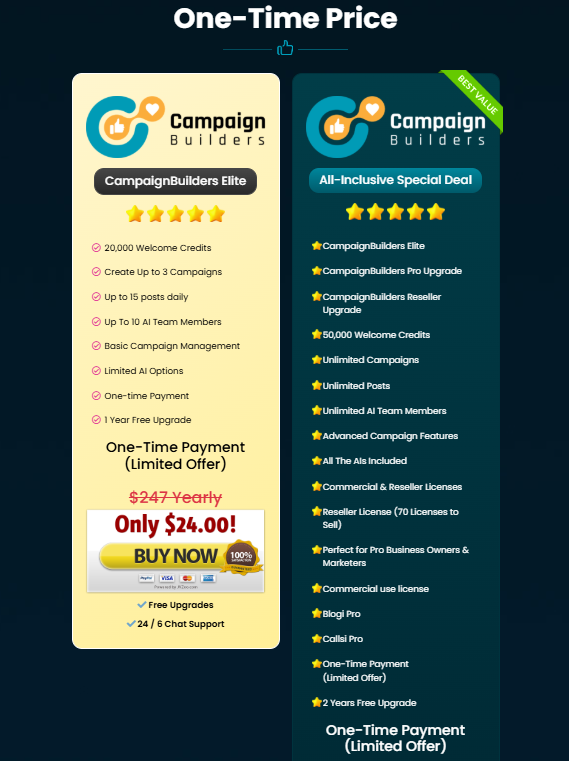
CampaignBuilders FE, sold as CampaignBuilders Elite, is the entry point into the platform. It’s built for testing the waters rather than running a full agency operation through it. You get 20,000 welcome credits, up to three campaigns, and up to 15 posts daily. You also get access to as many as 10 AI Team Members.
Basic campaign management is included, which covers the core workflow of setting up a campaign and generating content for it. AI access on this tier is described as limited, so you won’t get the broader model selection that PRO offers.
For a solo marketer or small business testing whether CampaignBuilders fits their workflow, this is a sensible starting point. Three campaigns is plenty if you’re only promoting your own business. And 15 daily posts covers a fairly active social presence without needing more.
FE starts to show its limits with anyone managing multiple clients. It also shows limits for anyone wanting a wider range of AI models to pull from. The three-campaign cap becomes a real bottleneck the moment you take on a second client or launch a second product.
CampaignBuilders FE is a one-time payment with one year of free upgrades included. That’s a reasonable deal if the feature set matches what you actually need.
FE Key Takeaways
- 20,000 welcome credits
- Up to 3 campaigns
- Up to 15 posts daily
- Up to 10 AI Team Members
- 1 year of free upgrades
CampaignBuilders PRO (OTO 1) Review
CampaignBuilders PRO is where the platform starts making sense for people using it professionally rather than casually. It bumps welcome credits to 50,000 and, more importantly, removes the campaign cap entirely.
Unlimited revisions and edits are included too, which matters more than it sounds like on paper. AI drafts rarely land exactly right on the first pass. Being able to revise without hitting a wall changes how you actually use the tool day to day.
Multi-AI access is the other major upgrade, giving you the broader model selection instead of FE’s limited options. Combined with advanced campaign customization and Team Access, PRO is clearly built for agencies, freelancers, and busy businesses.
The Commercial License is arguably the biggest reason to upgrade if you’re planning to offer social media services to clients. Without it, you’re limited to using CampaignBuilders for your own business. That rules out a large chunk of the audience this platform seems to be targeting.
CampaignBuilders PRO is a one-time payment with two years of free upgrades, roughly double what FE includes. For anyone managing multiple campaigns or clients, the jump from FE to PRO is worth serious consideration.
PRO Key Takeaways
- 50,000 welcome credits
- Unlimited campaigns
- Unlimited revisions and edits
- Multi-AI access
- Commercial license and Team Access
Reseller License (OTO 2) Review
This CampaignBuilders OTO is a different kind of offer entirely. Instead of adding features to your own CampaignBuilders account, it gives you 70 licenses you can resell to other customers.
This is really only relevant if you’re interested in building a software resale business, separate from using CampaignBuilders for your own marketing. If you just want the tool for your own campaigns, this OTO doesn’t add anything to your workflow.
Marketers who already sell digital products, or run an audience interested in software deals, might see reselling licenses as a reasonable side offer. But the economics and terms of any reseller arrangement deserve real scrutiny before committing money to it.
I’d treat this one as a separate business decision, not an automatic add-on. Read the official reseller terms carefully. Check what support is provided and what happens if the core product changes.
Reseller Key Takeaways
- 70 resellable licenses
- Separate from normal CampaignBuilders usage
- Best suited to those interested in software resale
- Review official reseller terms before buying
Blogi AI PRO (OTO 3) Review
Blogi AI PRO, the third CampaignBuilders OTO in the funnel, takes CampaignBuilders outside of social media entirely and into blog content. It’s described as an autoblogging tool that can generate and publish articles to a blog on an ongoing basis. That’s a different workflow from the campaign-based social content the core platform focuses on.
The offer includes 50,000 free credits and access to all included AI models. It also supports managing multiple blogs under one commercial license. For affiliate marketers and website owners, this is arguably the most relevant OTO in the entire funnel. It addresses content production for an entirely separate channel.
Automated blog posting doesn’t equal search rankings, and that distinction matters a lot here. SEO outcomes depend on content quality, competition, search intent, and technical factors. Autoblogging software can’t control any of that on its own. Treat Blogi as a production tool, not a ranking guarantee.
For anyone running an affiliate site or content-heavy blog, Blogi AI PRO is worth evaluating on its own merits. Don’t treat it as an automatic bundle with CampaignBuilders. The two products solve different problems, even though they share a checkout page.
Blogi AI PRO Key Takeaways
- AI autoblogging for ongoing article publishing
- 50,000 free credits
- All AI models included
- Multi-blog support with commercial license
- Does not guarantee rankings or traffic
Callsi PRO (OTO 4) Review
Callsi PRO is the outlier in this funnel, and it has almost nothing to do with content creation. It’s positioned as an AI-powered phone automation tool. It handles incoming and outgoing calls, follows up with leads, qualifies prospects, and books appointments.
The PRO tier includes unlimited campaigns and claims of 10x more call capacity. It also adds access to all available voices, 50,000 welcome AI credits, and instant call placement. Team Access and a commercial license are included as well, along with two years of free upgrades.
Phrases like “human-like” and “10x more calls” are marketing claims, not measured outcomes, and they should be read that way. There’s no way to verify those figures from the supplied material, so treat them as the vendor’s positioning rather than fact.
This upgrade only makes sense if your business genuinely depends on phone-based lead handling. If calls aren’t a big part of how you handle leads, Callsi won’t add value just because it’s bundled in.
Callsi PRO Key Takeaways
- AI phone agents for calls, follow-ups, and appointment booking
- Unlimited campaigns and 50,000 welcome credits
- Access to all available voices
- Team Access and commercial license included
- Marketing claims like “10x more calls” are unverified
CampaignBuilders Pricing
CampaignBuilders pricing currently follows a one-time promotional model across every CampaignBuilders OTO, rather than a recurring subscription. That’s typical for a launch like this. Still, double-check the checkout page before buying, since promotional pricing and terms can shift.
The listed prices below reflect the current promotional page. Launch pricing on platforms like this tends to rise over time. Don’t assume today’s number will still be there next month.
Offer | Main Purpose | Key Features | Price |
CampaignBuilders Elite | Core social campaigns | 3 campaigns, 10 AI Team Members, limited AI | $47 |
CampaignBuilders PRO | Advanced campaign features | Unlimited campaigns, multi-AI, commercial license | $67 |
Reseller License | Software resale | 70 resellable licenses | $197 |
Blogi AI PRO | Blog automation | Autoblogging, multi-blog, commercial license | $67 |
Callsi PRO | AI phone automation | AI calling, unlimited campaigns, commercial license | $67 |
FE vs PRO vs OTO Comparison
Feature | FE | PRO | Reseller | Blogi PRO | Callsi PRO |
Target User | Solo/testing | Agencies/pros | Resellers | Bloggers/affiliates | Phone-dependent businesses |
Campaigns | Up to 3 | Unlimited | — | — | Unlimited |
AI Access | Limited | Multi-AI | — | All models | AI calling |
Credits | 20,000 | 50,000 | — | 50,000 | 50,000 |
AI Team Members | Up to 10 | Expanded | — | — | Team Access |
Revisions | Basic | Unlimited | — | — | — |
Team Access | No | Yes | Resell rights | — | Yes |
Commercial License | No | Yes | Resell rights | Yes | Yes |
Main Purpose | Core platform | Professional use | Reselling | Blog content | Phone automation |
Refund Policy & Money-Back Guarantee

The official CampaignBuilders and PRO pages currently advertise a 30-day money-back guarantee. According to the PRO page, customers can use the product for up to 30 days. If it doesn’t work out, they can request a full refund through support.
That’s a fair amount of time to actually test the platform against your own workflow before committing long-term. Still, refund terms and processes can change. It’s worth confirming the current policy at checkout, especially if you’re buying multiple upgrades in one purchase.
What I Like About CampaignBuilders
These are the strongest points that came up while putting this CampaignBuilders review together.
- AI Team Members – Splitting tasks across roles beats re-prompting one assistant for every single job.
- Brand customization – Feeding the AI your brand context produces noticeably more usable first drafts.
- Multi-AI access on PRO – More model options means more flexibility for high-volume content production.
- Unlimited campaigns on PRO – Removes the biggest structural limitation for agencies and multi-brand users.
- Commercial License – Opens the door to actually offering these services to paying clients.
- Multilingual support – A real advantage for anyone marketing to more than one language group.
- One-time payment model – No recurring subscription for the core offers, at least under current terms.
What I Don’t Like About CampaignBuilders
- FE’s campaign limit – Three campaigns runs out fast for anyone beyond a single small business.
- FE’s limited AI access – Casual users get less model variety than the PRO tier offers.
- Credit-based usage – Heavy content production depends on available credits, which is worth watching.
- Several separate upgrades – The funnel structure can make it unclear what a given user actually needs.
- Not every OTO fits every buyer – Callsi and Blogi solve very different problems from the core platform.
- AI output still needs review – None of this removes the need for a human to check content before it publishes.
Who Should Use CampaignBuilders?
This part of the CampaignBuilders review matters more than any feature list. The platform only pays off for the right kind of user.
- Social media marketers who need a steady stream of campaign content without starting from scratch each time.
- Affiliate marketers running promotions across multiple products or offers.
- Agencies managing social content for several clients under one system.
- Freelancers offering social media marketing as a service.
- Small businesses looking to automate part of their content production.
- Content creators who need to publish consistently without burning hours on manual scheduling.
- Marketers managing multiple brands, where PRO’s unlimited campaigns and brand customization do the most work.
Who Shouldn’t Use CampaignBuilders?
- Anyone who rarely posts or publishes online content in the first place.
- Marketers who strongly prefer a fully manual, hands-on content process.
- Users who only need a basic AI writing assistant and nothing more structured.
- Businesses with no real need for campaign-level organization.
- Anyone considering every OTO without a specific, identified use case for each one.
Is CampaignBuilders Beginner-Friendly?
One question that comes up a lot in any CampaignBuilders review is how steep the learning curve actually is.
The core concept isn’t hard to follow. Set up your brand, configure your AI team, choose your content preferences, generate, review, and publish. That basic loop is straightforward enough for someone with no prior experience with AI marketing tools.
That gets more involved once you start layering in AI Team Members, multiple campaigns, brand voice settings, and publishing. None of it is complicated on its own. There’s more surface area here than a simple AI writing tool. Expect a short learning curve while you figure out how the pieces fit together.
If this CampaignBuilders review is your first introduction to the platform, start with the FE plan. It’s a reasonable way to learn the basics before deciding if PRO’s extra capacity is worth it. Trying to configure every feature on day one is more likely to overwhelm a beginner than help them.
Is CampaignBuilders Worth It?
Is CampaignBuilders worth it for you specifically? That’s really the only version of this question worth answering. It depends almost entirely on how you plan to use it, rather than being a flat yes or no. For someone only producing content for their own single business, FE may genuinely cover what you need. Paying for PRO’s extra capacity would just be money spent on features you won’t use.
For marketers, freelancers, and agencies working across multiple campaigns or clients, PRO is where the platform earns its price. Unlimited campaigns, unlimited revisions, broader AI access, Team Access, and the commercial license all address real friction points. Those issues come up once you’re operating at scale.
Blogi AI PRO only makes sense if blogging and SEO content are actually part of your strategy. If they’re not, it’s not worth adding regardless of the bundled pricing. Callsi PRO is even more specific, only relevant if AI phone automation genuinely fits how your business handles leads and appointments.
The Reseller License sits apart from all of this entirely, as a separate business opportunity rather than a marketing feature. It’s worth considering only if reselling software interests you as its own venture.
So no, this isn’t a “buy everything” recommendation. It’s a “match the purchase to what you actually need” situation. That’s honestly how most software funnels like this should be evaluated.
CampaignBuilders Pros & Cons
Here’s the full CampaignBuilders pros and cons breakdown side by side, pulling together everything covered in this review.
Pros
- AI Team Members structure content work
- Brand customization improves output relevance
- Multiple AI models available on PRO
- Unlimited campaigns on PRO
- Unlimited revisions on PRO
- Commercial License enables client work
- Multilingual content support
- Blog and phone automation extend the ecosystem
Cons
- FE’s campaign limit is restrictive
- FE offers limited AI model access
- Credit usage needs monitoring
- Several separate upgrades to evaluate
- Not every OTO fits every buyer
- AI output still requires human review
- Some marketing claims are unverified
- Additional products solve different problems
Frequently Asked Questions
These are the questions that come up most often around this CampaignBuilders review.
What is CampaignBuilders?
Based on this CampaignBuilders review 2026, CampaignBuilders is an AI-powered marketing platform built around social media campaign creation and automation. It uses AI Team Members, brand customization, and campaign management to organize content production in one place.
Is CampaignBuilders beginner-friendly?
Yes, the core workflow is simple to follow, though the range of features means beginners may need a short learning period. Starting with FE is a reasonable way to get familiar with the platform first.
What does CampaignBuilders FE include?
FE includes 20,000 welcome credits, up to three campaigns, and up to 15 posts daily. It also includes up to 10 AI Team Members, basic campaign management, limited AI options, and one year of free upgrades.
What is included in CampaignBuilders PRO?
CampaignBuilders PRO includes 50,000 welcome credits and unlimited campaigns. It also adds unlimited revisions, multi-AI access, advanced campaign customization, Team Access, a commercial license, and two years of free upgrades.
Does CampaignBuilders support multiple AI models?
Yes. PRO specifically advertises multi-AI access, and the interface shows models including Gemini, GPT, Claude, and Grok, depending on your plan.
How many AI Team Members can I create?
FE supports up to 10 AI Team Members. PRO expands the platform’s overall AI capabilities beyond that limit.
Does CampaignBuilders support multilingual content?
Yes. The platform shows language options including English, Hindi, Chinese, Spanish, French, Arabic, and a custom setting.
Can I schedule social media content?
Yes. CampaignBuilders includes a content scheduling and publishing workflow, including a direct Buffer connection.
Does CampaignBuilders integrate with Buffer?
Yes. You can select a Buffer organization, choose a social channel, and set a publishing date and time directly from inside CampaignBuilders.
Does CampaignBuilders offer a commercial license?
The PRO plan includes a commercial license. The official page describes it as letting users provide social media marketing services for other businesses.
What is Blogi AI PRO?
Blogi AI PRO is the blogging-focused product in the CampaignBuilders ecosystem, built to automate the creation and publishing of blog articles.
What is Callsi PRO?
Callsi PRO is an AI phone automation product that handles calls, lead follow-ups, prospect qualification, and appointment booking.
What is the CampaignBuilders Reseller License?
The Reseller License provides 70 licenses that buyers can resell to other customers, separate from using CampaignBuilders for your own marketing.
Is CampaignBuilders a one-time payment?
The current promotional offers are advertised as one-time payments. Since pricing and terms can change, check the checkout page for the latest details before purchasing.
Does CampaignBuilders offer a money-back guarantee?
Yes. The official pages currently advertise a 30-day money-back guarantee, with refunds available through support.
Is CampaignBuilders worth it for beginners?
Is CampaignBuilders worth it if you’re just starting out? Probably only through the FE plan. It lets you learn the platform without committing to PRO’s full feature set right away.
Which CampaignBuilders plan should I choose?
FE is the logical starting point for solo marketers or small businesses testing the platform. PRO makes more sense if you need unlimited campaigns, broader AI access, or Team Access for client work.
Final Verdict
Wrapping up this CampaignBuilders review, the platform stands out from typical AI writing tools. It’s built around a full campaign workflow rather than a single prompt box. The AI Team Members concept, brand customization, and built-in publishing tools give it a more organized structure than most competitors.
FE works fine as an entry point for testing the platform. But PRO is where the product gets worth serious consideration. Think unlimited campaigns, unlimited revisions, broader AI access, and the commercial license. The OTOs beyond that need to be judged on their own merits. Blogi AI PRO is a solid pickup if blogging fits your strategy. Callsi PRO only matters if phone leads are part of your business. The Reseller License is really its own separate opportunity.
None of this guarantees results, and it shouldn’t be sold that way. What CampaignBuilders can realistically offer is less time on repetitive content, plus a more organized system for ongoing campaigns. That’s a fair trade if that’s the problem you actually have.
CampaignBuilders earns this rating for its structured approach to AI-assisted marketing and the real value PRO adds for professional users. That’s balanced against FE’s real limitations, and a funnel that needs some thought before buying every add-on.
Best for: Marketers, agencies, affiliate marketers, freelancers, and businesses that need an ongoing AI-assisted content and campaign workflow.
Best starting point: CampaignBuilders FE.
Best for professional users: CampaignBuilders PRO.