(This post may contain affiliate links. I may earn a small commission at no extra cost to you.)
Amazon Kindle Direct Publishing made self-publishing easy to start. You don’t need an agent or a publisher. You upload a book, and Amazon prints and ships it when someone buys.
That part is simple. Everything before it usually isn’t.
Depending on what you want to publish, you may need to plan a plot, build a puzzle grid, lay out a planner page, or generate artwork. Doing that by hand takes real hours.
This is where a good KDP tool helps. It takes one slow task off your plate so you can spend time on the parts that matter: the idea, the niche, and the polish. Finding the best KDP tools for your specific project is really about matching the tool to the bottleneck you actually have.
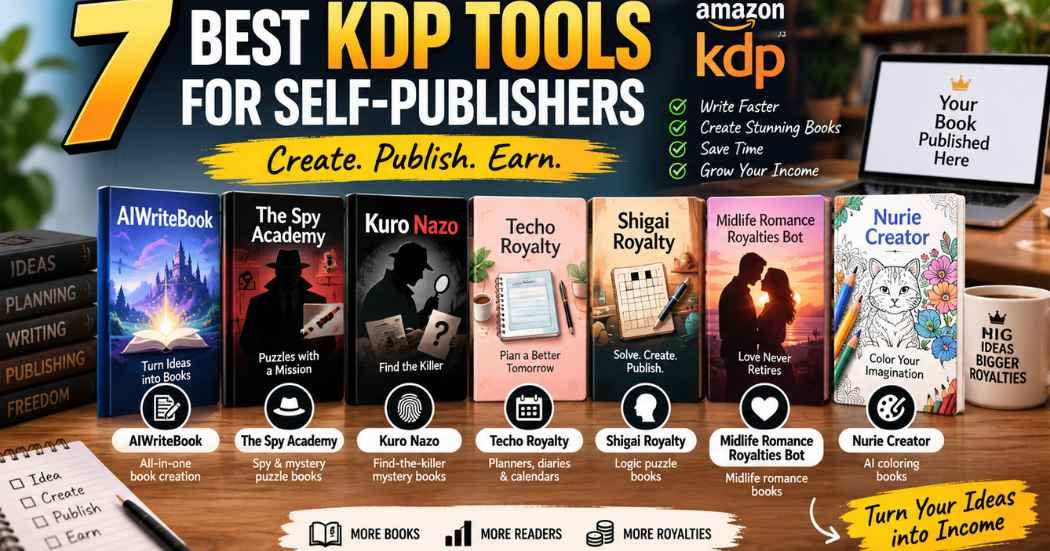
Below are the 7 best KDP tools worth knowing about in 2026. They’re built for different jobs. One is for AI-assisted fiction. Three cover different corners of the puzzle-book world. One is for planners, one for math workbooks, one for coloring books. None of them do everything, and none will publish a bestseller while you sleep. Each one removes a specific bottleneck, which is really what you should look for in the best tools for KDP rather than picking whichever one has the flashiest sales page.
One note before we start: none of this guarantees sales. Your niche, book quality, pricing, and competition all matter more than any single tool.
Quick Overview: The 7 KDP Tools
Tool | Best For | Main Use |
Cozy Co-Author | Fiction authors | AI-assisted cozy fantasy novels |
Shigai Royalty | Puzzle creators | Whodunit logic puzzle books |
Kuro Nazo (Kuron) | Beginners | Find-the-killer mystery books |
Techo Royalty | Planner creators | Planners, diaries, calendars |
Sansuu Royalty | Educational creators | Math workbooks |
Manaka Royalty | Puzzle publishers | Multi-puzzle books |
Nurie Creator | Coloring-book creators | AI-assisted coloring books |
AIWriteBook — Best Overall KDP Tool
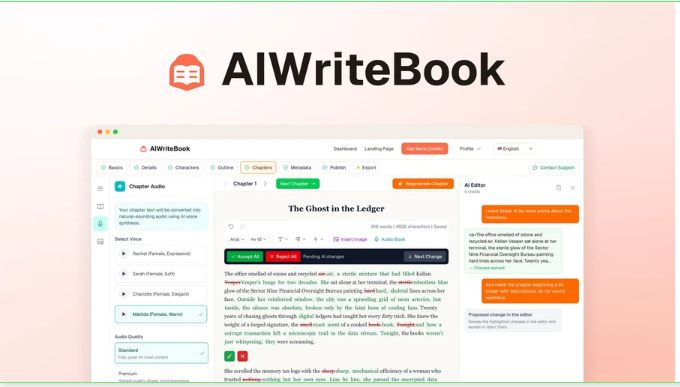
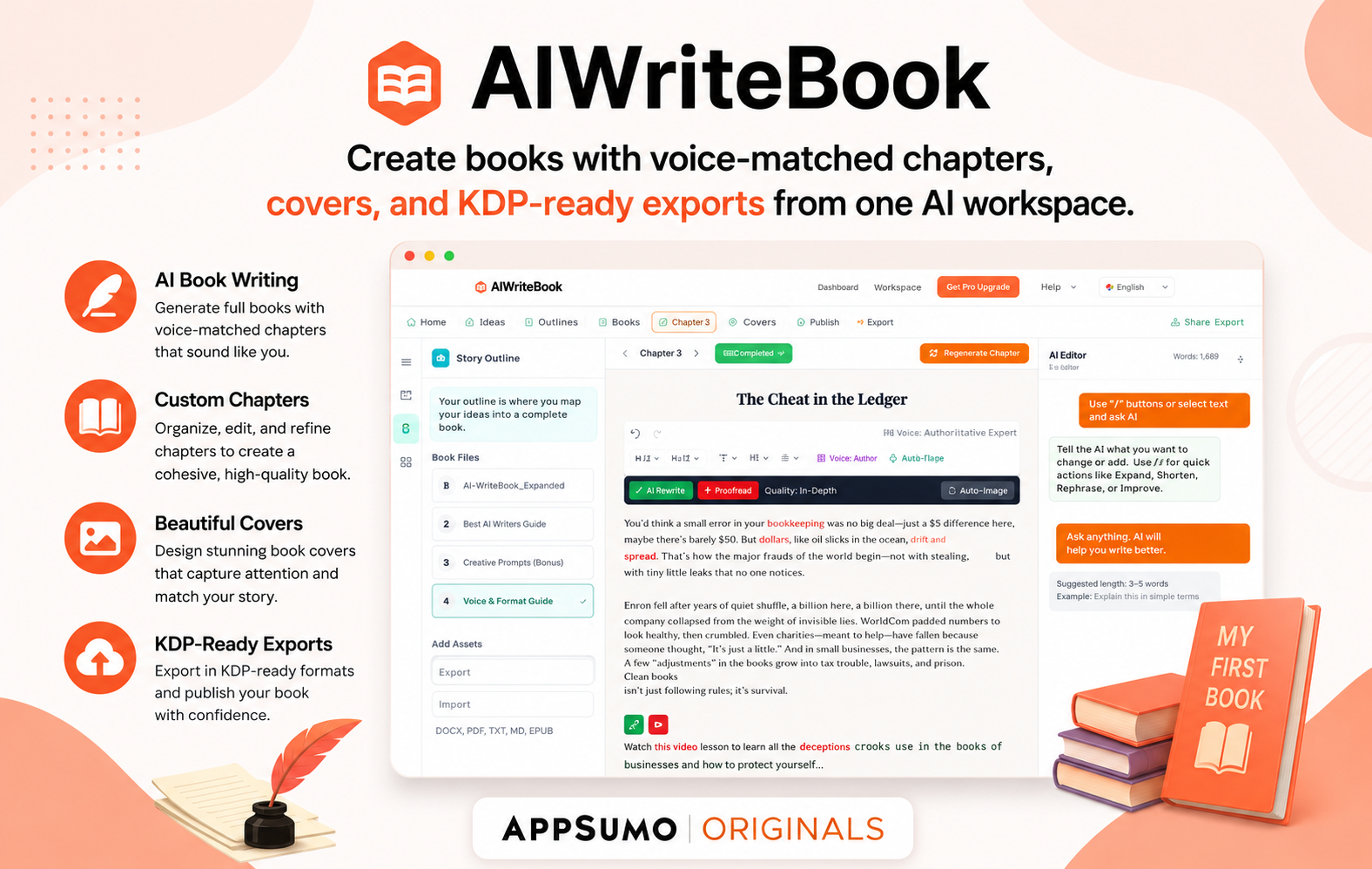
AIWriteBook is an all-in-one AI-powered book creation platform designed for authors and self-publishers. Instead of focusing on only one type of KDP book, it aims to support much of the publishing workflow in one place.
How Does It Work?
You can start with a book idea and use AI to help develop the outline and chapters. The platform can also assist with illustrations, cover creation, formatting, and preparing files for publishing.
One useful feature is the ability to work with your existing writing style, which can help make AI-generated content more consistent with your preferred voice.
What Can You Create?
AIWriteBook can be used for different types of fiction and nonfiction projects, including:
- Novels
- Short books
- Guides
- Educational content
- Illustrated books
- Nonfiction books
- Other long-form publications
Key Features
- AI-assisted book writing
- Outline and chapter creation
- Writing-style tools
- Illustration generation
- Cover creation
- Book formatting
- EPUB, PDF and DOCX exports
- KDP-related metadata tools
- Keyword research features
Who Is It Best For?
AIWriteBook is best for authors and self-publishers who want a more complete book-production workflow rather than a tool dedicated to only one KDP niche.
Pros
- All-in-one book creation workflow
- AI writing and outline tools
- Writing-style training
- Cover and illustration generation
- KDP-ready exports
- Built-in keyword research and category selection
Cons
- Uses a credit system
- Higher tiers cost considerably more
- AI-generated content still needs human editing and quality control
Verdict
If you want one versatile tool for writing and preparing different types of books, AIWriteBook is the strongest overall choice in this list.
Shigai Royalty

What Is Shigai Royalty?
Shigai Royalty is cloud software built around one puzzle type: story-driven mystery logic puzzles, sometimes called “Murdoku” style. A buyer studies a cast of suspects and a set of true clues to figure out who’s guilty, using pure deduction.
How Does It Work?
You choose a difficulty (five tiers) and a grid size, from 6×6 up to 16×16, plus a cast of suspects and rooms. The engine builds the case and checks that each puzzle has exactly one solution before adding it to your book. That check matters: a hand-built puzzle with two possible answers tends to earn a one-star review fast.
What Can You Create?
Whodunit puzzle books, sold as KDP paperbacks or printables on sites like Etsy. The tool also has a “Heist” mode (find the thief), custom casts with photo uploads, and output in eight languages.
Key Features
- Verified single-solution puzzles across 5 difficulty levels and grids up to 16×16.
- Custom suspects, rooms, and photo uploads.
- Built-in book cover studio.
- Full page designer with KDP trim sizes and bulk generation.
- 8 output languages, 2 artwork styles.
- Unlimited PNG exports plus print-ready PDF.
Who Is It For?
Publishers who want to focus on mystery puzzle books, beginners included, since the page says it needs no writing or puzzle-design skill. It’s not a fit if you want word searches, sudoku, or other formats.
Pros
- Puzzle verification is a real, testable claim.
- Multiple difficulty levels and grid sizes support a full series.
- Cloud-based, nothing to install.
- Full commercial rights on exported books.
Cons
- Narrow by design: this is a mystery-puzzle tool, not a general publisher.
- No refund policy; the FAQ says all sales are final.
- Income screenshots and testimonials come from members and can’t be checked.
- Test a sample export yourself before building a full catalog.
Pricing
No fixed price is listed. The page shows a large “total value” figure, with the real launch price shown only at checkout. No recurring fee is mentioned for the core offer.
Final Verdict
Best for: creators who want to focus on mystery logic puzzles and like that the core claim, one verified solution per puzzle, is something you can test yourself.
Kuro Nazo (Kuron)

What Is Kuro Nazo?
Kuro Nazo, sold under the page name “kuron.html,” is a second mystery-puzzle tool from the same team behind Shigai. Where Shigai focuses tightly on the puzzle itself, Kuro Nazo tries to hand you the whole book: suspects, clues, an answer key, a cover, and an Amazon listing.
How Does It Work?
You pick a difficulty and a suspect count (the page claims up to 50,000, far more than a real book would use, but the range covers books of different lengths). The software generates the mystery, the clues, and a full solution page. A built-in cover maker and Amazon listing maker handle two more steps you’d otherwise do in separate apps.
What Can You Create?
Find-the-killer puzzle books, similar in category to Shigai but built around a more all-in-one process. You get up to 100 PDF exports a month plus unlimited PNGs, and the interface runs in 10 languages (books are output in English).
Key Features
- Full find-the-killer books: suspects, clues, and answer key generated together.
- 5 difficulty tiers with up to 50,000 suspects per book.
- Built-in cover maker and Amazon listing maker.
- Unlimited PNG exports, up to 100 PDF exports a month.
- 10-language interface.
- No API key, credit system, or subscription.
Who Is It For?
Beginners who want fewer separate tools. If you’d rather have one app handle the puzzle, cover, and listing copy instead of stitching those together, this is the more complete workflow of the two mystery tools here.
Pros
- Combines puzzle, cover, and listing copy in one place.
- Beginner-friendly, with step-by-step training included.
- No subscription advertised.
- Supports selling on Etsy, Lulu, and Blurb too, not just Amazon.
Cons
- Same limit as Shigai: one puzzle type, not a general tool.
- No refund policy; the FAQ says all sales are final.
- AI cover art and listing copy still need a human review pass.
- Income and rank screenshots come from members and can’t be checked.
Pricing
Like Shigai, the page shows a stacked “total value” against a struck-through “regular price,” with the real price shown at checkout. No monthly fee is advertised.
Final Verdict
Best for: beginners who want one tool to take a find-the-killer book from idea to a finished cover and listing, without switching between several apps.
Techo Royalty (Access Techo Royalty)

What Is Techo Royalty?
Techo Royalty is a browser-based, drag-and-drop planner editor for KDP and Etsy sellers. Instead of building planner pages one at a time in Canva, you pull from 303 stock templates across more than 30 niches, plus drop-in sections.
How Does It Work?
The page calls this “section-stacking.” Instead of designing a page from scratch, you drop in ready-made pieces, habit grids, mood rows, kanban boards, time slots, and the editor handles spacing and alignment. A bulk book builder lets you set page counts and sections for a whole planner at once.
What Can You Create?
Daily and weekly planners, diaries, journals, habit trackers, budgeting books, and niche planners for fitness, ADHD, pregnancy, and pets. The tool also has a real dated year-calendar with a configurable week-start day.
Key Features
- 303 stock templates across 30+ niches.
- 30+ drop-in section types.
- Bulk book builder for a whole planner at once.
- Dated year-calendar generator.
- Auto-save every few seconds with restore-on-reload.
- PNG and PDF export, with copyright and instruction pages built in.
Who Is It For?
Anyone who wants to publish planners, diaries, or calendar books without hand-building every page in Canva. Good for sellers who want to move fast across many templates rather than perfect one page.
Pros
- Large, sorted template library saves real setup time.
- Real editor features: multi-select, snap guides, undo history.
- Auto-save protects against lost work.
- Includes a cover-dimension calculator, which solves a common KDP formatting headache.
Cons
- Templates still need customizing so your listing doesn’t look like everyone else’s.
- Planner niches can be competitive; a good-looking book doesn’t guarantee sales.
- No refund policy stated.
- “Founders” launch pricing may not match what you’d pay later.
Pricing
The page shows a launch price with a stacked value list but no fixed dollar figure; the real price appears at checkout. No recurring fee is mentioned for the core editor.
Final Verdict
Best for: creators who want to publish planners, diaries, or calendar books and would rather stack ready-made sections than design every page from scratch.
The Spy Academy — Best for Spy & Mystery Puzzle Books
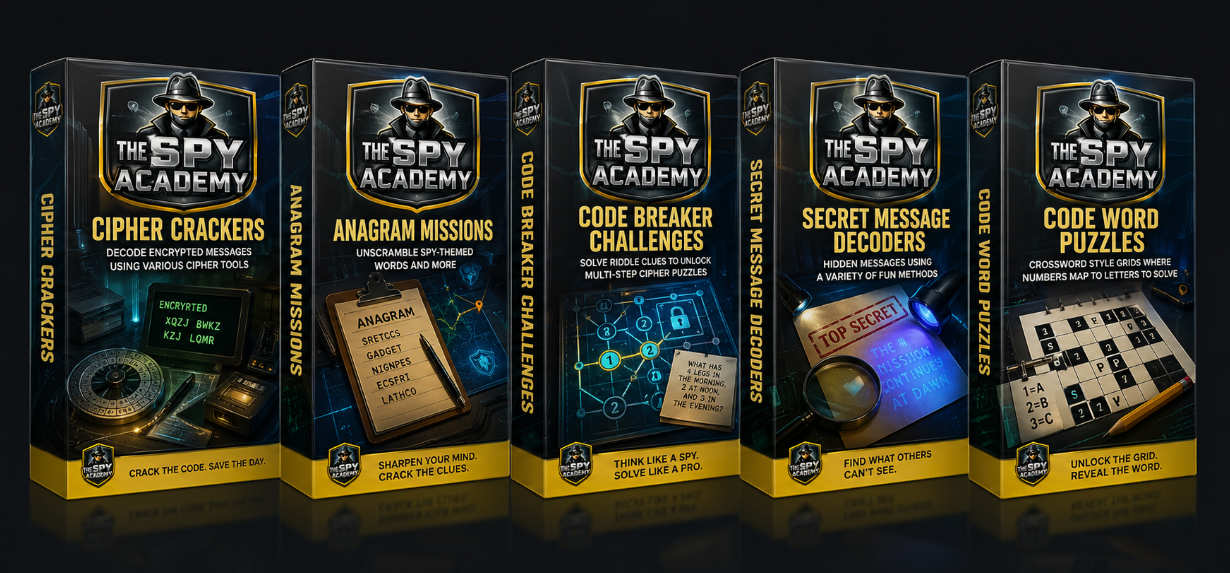
The Spy Academy is a specialized activity-book creation platform focused on the spy, mystery, and detective genre.
Instead of producing ordinary word searches or generic puzzle books, it focuses on cipher and code-based activities. The official site currently describes five main generators plus a Story Mission Builder.
How Does It Work?
You choose a generator, select options such as difficulty and audience, customize the page format, and download the resulting PDF.
The platform says its activities can be customized by page size, font size, color or black-and-white output, and answer-key placement.
What Can You Create?
The platform currently includes:
- Cipher puzzle books
- Anagram missions
- Code breaker challenges
- Secret message decoder books
- Code word puzzles
- Spy-themed activity books
- Spy mission storybooks
The Story Mission Builder combines narrative elements with puzzles and currently has a stated limit of 25 story builds per month, while the activity generators are advertised with unlimited PDF generation.
Key Features
- Nine cipher methods
- Anagram missions
- Code-breaker challenges
- Secret-message decoders
- Code-word puzzles
- Multiple difficulty levels
- 16 page sizes
- Color or black-and-white output
- Automatic answer keys
- Print-ready PDFs
- Commercial license
- KDP, Etsy and TPT-oriented workflows
- No API key required
Who Is It Best For?
The Spy Academy is best for KDP publishers who want to build a catalog around spy, detective, mystery, and code-breaking activity books.
Pros
- Highly specialized niche
- Multiple puzzle formats
- Print-ready PDF output
- Commercial-use license
- Suitable for different age groups
- Can be used beyond KDP
Cons
- Focused mainly on spy/mystery content
- Less useful for traditional book publishing
- Story Mission Builder has a monthly generation limit
Verdict
For publishers specifically targeting spy and mystery activity books, The Spy Academy is one of the most specialized options in this list.
Midlife Romance Royalties Bot

The Midlife Romance Royalties Bot takes a completely different approach from the puzzle and planner tools above.
It is a custom ChatGPT-based writing system specifically designed for midlife/later-in-life romance books for Amazon KDP. The sales page says the bot contains nearly 8,000 characters of specialized instructions and guides users through the writing process chapter by chapter.
How Does It Work?
The system uses a four-phase workflow:
- Choose the book format and generate a pen name.
- Build the complete story bible.
- Write the book chapter by chapter.
- Generate publishing assets such as keywords, book description, and cover.
The page says the bot works with free and paid ChatGPT accounts.
What Can You Create?
The tool is specifically aimed at:
- Midlife romance novels
- Later-in-life romance
- Second-chance romance
- Romance stories involving mature characters
- Other romance concepts within the targeted niche
The sales page currently lists three target lengths: approximately 7,000, 13,000, and 24,000 words.
Key Features
- Custom ChatGPT bot
- Genre-specific romance instructions
- Story Bible generator
- Chapter-by-chapter workflow
- Pen-name generator
- Author bio generation
- KDP keyword suggestions
- Amazon book-description generation
- AI-generated cover
- Three book-length options
- Guided four-phase system
Who Is It Best For?
This tool is best for authors who specifically want to publish midlife or later-in-life romance books.
Pros
- Highly niche-specific
- Guided writing workflow
- Useful for beginners
- Includes KDP-oriented publishing assets
- Works inside ChatGPT
Cons
- Very narrow genre focus
- Requires careful editing of AI-generated writing
- Sales-page earnings examples are not guarantees
Verdict
If your goal is midlife romance publishing, this specialized bot may be more useful than a generic AI writing tool because its workflow is built around that specific genre.
👉Get Midlife Romance Royalties Bot
Nurie Creator
What Is Nurie Creator?
Nurie Creator is a cloud-based, AI tool for generating coloring-book art. Type a short prompt, like “cute cat,” and the software generates line-art images sized for KDP, without the shading or gray tones that plain AI image generators often add.
How Does It Work?
The creator, Ike Paz, built this to fix a specific problem: getting a clean, un-shaded AI coloring page used to mean long prompts and cleanup in separate image software. Nurie Creator takes a short prompt and returns four image options per request, already sized for KDP, skipping that extra cleanup step.
What Can You Create?
Children’s and adult coloring books, themed collections, and niche coloring pages, sold as KDP paperbacks or printable downloads. The page lists more than 10 built-in art styles.
Key Features
- Prompt-based image generation, four options per prompt.
- Output pre-sized for KDP trim sizes.
- Automatic image upscaling for print quality.
- Up to 100 PDF exports a month, unlimited PNG and JPG.
- Built-in book cover generator.
- 10+ built-in art styles.
Who Is It For?
Creators who want coloring books without illustration skills or a separate AI-image cleanup workflow. It’s aimed at beginners, though the trim-size presets also help if you’re already publishing and want to move faster.
Pros
- Short prompts instead of long, technical AI prompt writing.
- Output is already sized for KDP, skipping a manual resize step.
- Book cover generator built in.
- No API key setup needed.
Cons
- AI art still needs a quality check; occasional visual errors are common with AI image generation in general.
- The coloring-book niche can be crowded, especially for generic subjects.
- The FAQ states plainly: “there are no refunds or money back guarantees”.
- Confirm image rights fit your use case before building a catalog.
Final Verdict
Best for: creators who want to publish coloring books and would rather type a short prompt than fight with prompt engineering and image cleanup.
How These Best KDP Tools Compare
There’s no single winner among the best kdp tools on this list. These seven products solve different problems. A mystery-puzzle engine won’t help you publish a math workbook, and a planner editor won’t write your novel.
Tool | Main Purpose | Content Type | Ideal User |
AIWriteBook | AI-assisted book creation | Fiction, nonfiction & illustrated books | Authors & self-publishers |
The Spy Academy | Spy & mystery puzzle generation | Cipher, code & spy puzzle books | Puzzle & activity-book publishers |
Kuro Nazo | Mystery book creation | Find-the-killer books | KDP beginners |
Techo Royalty | Planner creation | Planners, diaries & calendars | Low-content sellers |
Shigai Royalty | Logic-puzzle generation | Mystery whodunit books | Puzzle-niche publishers |
Midlife Romance Royalties Bot | AI-assisted romance writing | Midlife romance books | Romance KDP authors |
Nurie Creator | AI coloring-page generation | Coloring books | Visual-niche beginners |
Which KDP Tool Is Best for You?
If you want to write fiction: Start with Cozy Co-Author. It’s the only tool here built for long-form storytelling instead of puzzles or worksheets, and its continuity system targets the exact problem that stalls most first-time novelists.
If you want mystery puzzle books: Shigai focuses on verified single-solution logic puzzles. Kuro Nazo widens the job to include the cover and listing, which helps if you’d rather skip a separate design tool.
If you want planners: Techo Royalty is the dedicated option, built around a template library and section-based editor.
If you want educational workbooks: Sansuu Royalty is the only tool here built for math content and automatic answer keys.
If you want to try multiple puzzle formats: Manaka Royalty’s breadth beats committing to one narrow puzzle type right away.
If you want coloring books: Nurie Creator is the clear pick here, since it’s built around AI image generation for line art specifically.
Are KDP Tools Worth It?
Sometimes, and it depends on whether the tool matches what you actually want to publish.
The real benefit is time. Formatting a planner page by hand, calculating 50 math answers, or checking that a logic puzzle has one solution are all slow when done manually. A tool that automates one of these steps can save real hours per book.
What none of them can do is guarantee a sale. A faster way to make 50 mediocre books is still a mediocre plan. Your books still need to be accurate, well-formatted, and honestly described, and Amazon holds publishers responsible for meeting its content rules no matter which tool built the book.
There’s also a compliance piece worth knowing. Amazon currently requires KDP publishers to disclose when a book’s text, images, or translations were AI-generated. That rule doesn’t go away just because you edited the output afterward. Amazon treats AI-generated content differently from AI-assisted content where you did real creative work. Before publishing anything built with an AI tool, read Amazon’s current KDP tools for beginners guidance and its content policy directly, rather than assuming a sales page has already covered it.
Beyond compliance, plan to review every generated book yourself for accuracy, repeated content, formatting issues, and anything that could read as misleading. None of these tools take that responsibility off your plate.
Tips for Choosing the Right KDP Tool
- Pick your publishing model first, then the tool. Novel, puzzle book, planner, workbook, or coloring book: know which one you’re building before you shop.
- Check whether the tool saves real time. It should remove a repeat task, not give you one more app to manage.
- Look for customization, not just templates. A listing that looks like a thousand others is a hard sell.
- Read the commercial-rights terms. Confirm you can legally sell what the tool makes, especially AI-generated art or text.
- Check for recurring costs. Some tools are one-time; others may add paid tiers later. Read the fine print.
- Ask if you’ll still need other software. A “does everything” tool may still leave gaps, like a keyword tool or a proofreading pass.
- Research real demand in your niche first. No tool fixes a niche that’s already saturated.
- Don’t confuse volume with quality. A smaller catalog of genuinely useful books tends to hold up better than a big pile of rushed ones.
Final Verdict: Which Are the Best KDP Tools?
None of these seven are the best for everyone; they’re built for different jobs. Cozy Co-Author stands out for AI-assisted fiction. Shigai and Kuro Nazo cover two angles on mystery puzzle books, one narrow and specialized, one broad and all-in-one. Techo Royalty is the dedicated planner tool. Sansuu Royalty is built for math workbooks. Manaka Royalty trades specialization for breadth across puzzle formats. Nurie Creator is the coloring-book pick.
The best KDP tools for you depend on what you’re actually trying to publish, not which sales page makes the biggest promises. Among the best tools for amazon kdp covered here, the right pick is the one built for your specific niche, not the one with the biggest bonus stack. If you’re just starting out, pick one niche, choose the tool built for it, and finish one genuinely good book before scaling a catalog.
Frequently Asked Questions
What are the best KDP tools for beginners?
Among the best KDP tools for beginners, it really depends on your niche. Kuro Nazo and Nurie Creator both lean on beginner-friendly, prompt-or-click workflows. Techo Royalty’s drag-and-drop editor and Sansuu Royalty’s automated math generation are also approachable if planners or workbooks fit your goals better. Together, they cover most of the best tools for KDP beginners tend to search for first.
What is Amazon KDP?
Amazon Kindle Direct Publishing is Amazon’s self-publishing platform. It lets authors and publishers sell eBooks, paperbacks, and hardcovers without a traditional publisher.
Can KDP tools guarantee sales?
No. A tool can speed up creation, but it can’t guarantee rankings, reviews, or royalties. Results depend on your niche, book quality, competition, pricing, and marketing.
Can I use AI to create KDP books?
Yes, but Amazon requires disclosure when a book’s text, images, or translations were AI-generated. Check Amazon’s current KDP guidelines, since the line between AI-assisted and AI-generated content affects how you label your book.
Which tool is best for puzzle books?
There’s no single answer. Shigai focuses on verified whodunit logic puzzles. Kuro Nazo widens that into a full book-building workflow with covers and listings. Manaka Royalty covers a broader range of formats, from crosswords to sudoku variants. A few of these tools, including Shigai and Techo Royalty, also bundle a basic KDP keyword research tool as a bonus, which is worth knowing if you’d like some help narrowing down a niche once you’ve picked your format.
Which KDP tool is best for planners?
Techo Royalty is the most focused planner option, with a dedicated drag-and-drop editor, a 303-template library, and a real dated calendar generator.
Do I need to edit AI-generated content before publishing?
Yes, and it matters beyond quality. Amazon’s disclosure rules depend on whether AI created the content, not on how much editing happened after. Heavy edits don’t automatically turn AI-generated content into human-written content for disclosure purposes, so check Amazon’s current policy instead of assuming.
What should I check before publishing a KDP book?
Content accuracy, formatting, the cover, your description, your keywords and categories, your rights to the content, and whether your listing honestly represents what’s inside. Amazon requires publishers to follow its content and IP rules no matter which tool built the book.
Can I make money with KDP tools?
KDP tools can help reduce repetitive work and make certain publishing tasks easier, but they do not guarantee income. Treat them as productivity and creation resources rather than automatic income-generating systems. Your publishing strategy, content quality, niche selection, and marketing efforts still matter.