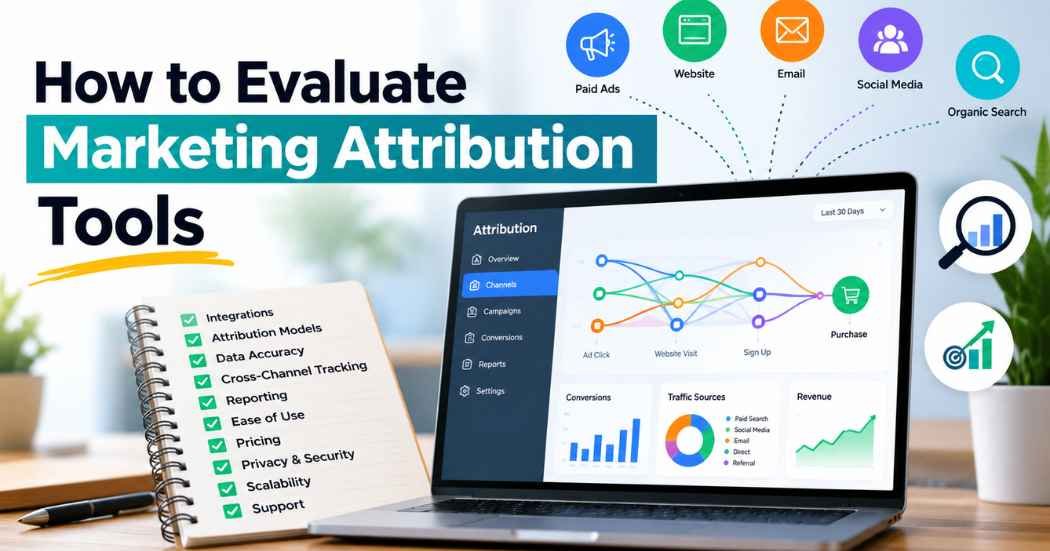
If you run marketing campaigns across several channels, you probably want to know which ones actually bring in customers. That is where attribution tools come in. But with so many options on the market, learning how to evaluate marketing attribution tools is the first step to picking one that truly fits your business. This guide walks you through the key factors to check before you commit to any platform.
What Are Marketing Attribution Tools?
Marketing attribution tools are software platforms that track how customers interact with your brand before they make a purchase or complete another goal, like signing up for a newsletter.
A customer might see your ad on social media, click a search result a few days later, and then finally buy after opening an email. Attribution software tries to connect these separate touchpoints into one clear picture.
This helps marketing teams understand which channels, campaigns, and messages are actually driving results. Instead of guessing, teams can use real data to see what is working and what is not.
At a basic level, these tools rely on conversion tracking. They follow a visitor’s actions across your website, ads, and other channels, then use that data to build a model of the customer journey.
Why Is It Important to Evaluate Marketing Attribution Tools?
Not all attribution platforms work the same way. Some are built for small businesses with simple needs. Others are designed for large companies running dozens of campaigns across many countries.
If you choose a tool without comparing your options, you might end up with software that:
- Does not integrate with the platforms you already use
- Cannot handle the amount of traffic or data your business generates
- Gives you confusing or inaccurate reports
- Costs more than your budget allows
- Requires technical skills your team does not have
That is why it makes sense to compare features, data quality, integrations, reporting, pricing, and usability side by side. A careful evaluation now can save you time, money, and frustration later. It also helps make sure the marketing analytics you rely on for decisions are actually trustworthy.
How to Evaluate Marketing Attribution Tools
Here is a step-by-step process you can follow when comparing different platforms.
1. Check Data Integration
Before anything else, look at what the tool can connect to. Most businesses use a mix of platforms, such as:
- Website analytics tools
- Customer Relationship Management (CRM) systems
- Advertising platforms (search and social ads)
- Email marketing platforms
- E-commerce or sales systems
Good data integration means the attribution tool can pull information from all these sources automatically. If a tool cannot connect to a platform you rely on daily, you may end up with gaps in your data. Always check the specific integrations a vendor lists on its official website, since this can change over time.
2. Compare Attribution Models
Attribution models are the rules a tool uses to decide which touchpoint gets credit for a conversion. Different attribution models can give you very different answers about which channels are performing well.
Some common models include:
- First-touch attribution – gives all the credit to the very first interaction a customer had with your brand.
- Last-touch attribution – gives all the credit to the final interaction before conversion.
- Linear attribution – spreads the credit equally across every touchpoint in the journey.
- Time-decay attribution – gives more credit to touchpoints that happened closer to the conversion.
- Position-based attribution – gives extra credit to the first and last touchpoints, with the rest shared among the middle ones.
- Data-driven attribution – uses statistical analysis of your own data to decide how much credit each touchpoint deserves.
There is no single “correct” model for every business. A tool that supports several models, and lets you switch between them, gives you more flexibility to understand your results from different angles.
3. Evaluate Cross-Channel Tracking
Customers rarely stick to one channel. They might scroll social media, click a search ad, read a blog post, and then return through email. This is why cross-channel attribution matters.
When evaluating a tool, check whether it can follow a customer across:
- Paid and organic search
- Social media platforms
- Email campaigns
- Display and video ads
- Offline touchpoints, if relevant to your business
A tool that only tracks one or two channels well will give you an incomplete view of your customer journey tracking, which can lead to wrong conclusions about what is really driving sales.
4. Check Data Accuracy and Reliability
An attribution tool is only useful if its data can be trusted. Before choosing a platform, ask:
- How does the tool collect its data?
- Does it explain its tracking methods clearly?
- Does it show consistent numbers over time, or do reports change dramatically for no clear reason?
- Does it account for common tracking issues, like ad blockers or browser privacy settings?
A transparent vendor should be willing to explain, in plain language, how their tracking works. If a company is vague about its methodology, treat that as a warning sign.
5. Review Reporting and Analytics
Once data is collected, it needs to be presented in a way your team can actually use. Look closely at the attribution reporting features, including:
- Dashboards that summarize performance at a glance
- Detailed conversion path reports
- Campaign-level performance breakdowns
- Customer journey visualizations
- Marketing ROI calculations by channel or campaign
Ask yourself whether the reports answer the questions your team actually asks, such as “Which campaign brought in the most paying customers?” or “Where are people dropping off before converting?”
6. Check Ease of Use
A powerful tool is not very helpful if your team struggles to use it. Consider:
- How long does setup usually take?
- Is the dashboard easy to read for non-technical team members?
- Is there a steep learning curve, or can most people pick it up quickly?
- Are reports easy to export and share with stakeholders?
If your team is small or does not have a dedicated data analyst, an easier interface may matter more than having every advanced feature available.
7. Compare Pricing
Pricing structures vary widely between attribution platforms. When comparing options, look at:
- Subscription costs and what is included at each plan level
- Any limits on traffic, users, or data volume
- Setup or implementation fees
- Extra charges for add-on features or higher usage
- Whether pricing scales reasonably as your business grows
Since pricing changes often and varies by vendor, it is best to check current plans directly on each company’s official website rather than relying on older price lists you may find elsewhere.
8. Check Privacy and Data Handling
Attribution tools handle sensitive customer data, so privacy matters. Before choosing a platform, review:
- How the tool stores and secures customer data
- Whether it supports consent management for regions with privacy laws
- Its approach to data retention and deletion
- Whether it is designed to work with regulations like GDPR or CCPA
This guide does not offer legal advice, so if privacy compliance is a major concern for your business, it is a good idea to involve your legal or compliance team in the final decision.
9. Evaluate Scalability
The tool that works for your business today should also be able to grow with you. Ask whether the platform can handle:
- Increasing website traffic
- More marketing campaigns and channels over time
- A growing number of team members and user accounts
- Larger volumes of historical data
Switching attribution tools later can be time-consuming, since you may lose historical data or need to retrain your team. Choosing a platform with room to grow can save you that hassle down the road.
10. Test the Tool Before Buying
Finally, do not commit to a full purchase without testing the platform first. Many vendors offer:
- Free trials
- Live demos with a sales representative
- Sample dashboards using demo data
- Detailed documentation and support resources
Testing lets you see how the tool performs with your actual data, not just marketing screenshots. It is one of the best ways to confirm whether a platform truly fits your needs before you sign a contract.
Marketing Attribution Tools Comparison Checklist
Use this simple checklist while comparing different platforms side by side.
Evaluation Factor | What to Check |
Integrations | Supported platforms |
Attribution Models | Available models |
Data Accuracy | Tracking and reporting quality |
Cross-Channel Tracking | Multiple marketing channels |
Reporting | Dashboards and analytics |
Ease of Use | Setup and usability |
Pricing | Plans and additional costs |
Privacy | Data handling and security |
Scalability | Ability to grow with the business |
Support | Documentation and customer service |
Common Mistakes When Choosing Attribution Tools
Even experienced marketers can make mistakes when picking attribution software. Watch out for these common pitfalls:
- Choosing based only on price. The cheapest option is not always the best fit for your goals.
- Ignoring integrations. A great tool is useless if it cannot connect to your existing platforms.
- Using only one attribution model. Relying on a single model can give a skewed picture of performance.
- Failing to test data quality. Numbers that look good on a demo are not always reliable in practice.
- Ignoring privacy requirements. Overlooking compliance needs can create legal or reputational risk later.
- Buying features the business does not need. Paying for advanced tools your team will never use wastes budget.
- Not checking scalability. A tool that fits today might not support your business next year.
- Not testing the software before purchase. Skipping a trial or demo often leads to costly surprises after signing up.
How to Choose the Right Marketing Attribution Tool
There is no single tool that is best for every business. The right choice depends on your specific situation. When making a final decision, think about:
- Business size. Smaller businesses may need something simple and affordable, while larger companies often need more advanced, scalable systems.
- Marketing channels. If you focus mainly on one or two channels, you may not need a tool built for complex cross-channel tracking.
- Data volume. Businesses with high traffic and many transactions need tools that can handle large datasets without slowing down.
- Technical resources. Consider whether you have in-house staff who can manage setup and ongoing maintenance, or whether you need something more hands-off.
- Reporting needs. Think about which reports matter most to your team and stakeholders.
- Budget. Set a realistic budget range before you start comparing, so you are not tempted by features you cannot afford long term.
- Integration requirements. List the platforms you must connect to before you even start shopping.
Weighing these factors together, rather than focusing on just one, will help you find a tool that truly fits your business rather than one that simply looks impressive in a demo.
Frequently Asked Questions
What are marketing attribution tools?
They are software platforms that track customer interactions across marketing channels and help businesses understand which touchpoints contribute to conversions.
How do marketing attribution tools work?
They collect data from your website, ads, email, and other channels, then apply an attribution model to assign credit to different touchpoints in the customer journey.
Why should businesses use attribution software?
It helps replace guesswork with data, showing which channels and campaigns are actually contributing to sales or leads.
What should I look for in an attribution tool?
Look at data integration, attribution models, cross-channel tracking, reporting quality, ease of use, pricing, privacy practices, scalability, and available support.
Which attribution model should I use?
It depends on your goals. Businesses that want a simple view often start with first-touch or last-touch models, while those wanting a fuller picture may prefer linear, time-decay, or data-driven models.
How accurate are marketing attribution tools?
Accuracy depends on the quality of the tool’s tracking methods and how well it integrates with your data sources. No attribution model is perfectly precise, since it is based on estimates of customer behavior.
How much do marketing attribution tools cost?
Pricing varies widely by vendor and depends on factors like data volume, features, and number of users. It is best to check current pricing directly on each provider’s official website.
Can small businesses use marketing attribution software?
Yes. Many vendors offer plans designed for smaller budgets and simpler needs, though the available features may be more limited than enterprise plans.
What is multi-touch attribution?
Multi-touch attribution is an approach that gives credit to multiple touchpoints in a customer’s journey, rather than crediting just one interaction.
How can I compare marketing attribution tools?
Use a structured attribution software comparison, checking each platform against the same criteria, such as integrations, models, reporting, pricing, and ease of use, so you can compare them fairly.
Final Thoughts
Choosing the right attribution platform takes more than picking the first option you find. By comparing integrations, attribution models, reporting features, pricing, privacy practices, and scalability, you can find a tool that matches your business rather than one that just looks good on paper.
Take time to test any platform with your own data before committing. What works well for one company may not work for another, so the best approach is to match your specific requirements against what each tool actually offers.